





Cosmo Talks to Graphic Artist Von Allan About Drawing and Storytelling
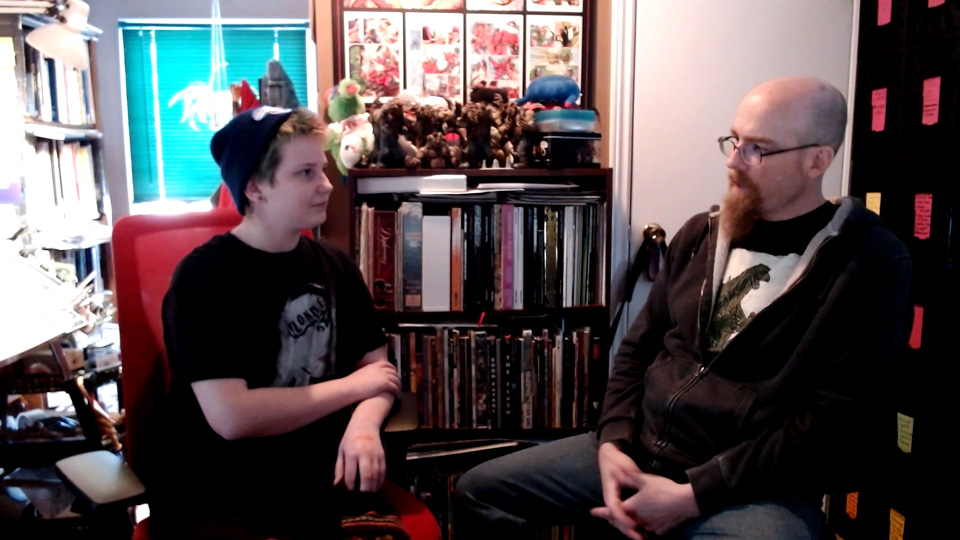
In February 2023 my niece Cosmo asked to do an interview with me for a school project. We chatted for about 25 minutes and Cosmo had a number of really good questions. I’ve been wanting to share the interview for quite a while, but since Cosmo is technically a minor it makes it a smidgen tricky to post the full video. But! Why not post a transcript of the interview instead, with a few screen shots to go with it? Yeah! What follows, then, is a lightly-edited transcript of our interview where we talk about my journey creating comics and graphic novels.
It was a lot of fun to do, especially when Cosmo asked me a pointed question about the “fellas” who watch over me in my studio! You’ll have to read the piece below to know exactly what I mean, but I wasn’t expecting a question like that!
The Interview
Cosmo: Hello and welcome to my interview with Von Allan. He is a graphic artist and also my uncle. Hello.
Von Allan: Hi!
Cosmo: Today I will be asking questions about your career and possibly other things.
Von Allan: Okay. I will do my best to give you good answers.
Cosmo: Okay. So… Question one. How did you start making comics and graphic novels?
Von Allan: Well, I’m a little bit weirder — or my situation is a bit weirder — than a lot of people. Because a lot of times you will hear interviews with artists and they are saying things like, ‘oh, I drew from the time I was two years old, and that’s what I did.’ I was not that guy. I did draw when I was a kid, but I didn’t draw [after that]. I didn’t have a lot of self-confidence when I was a teenager. I was pretty confident about one thing and that was I would not be able to draw. I didn’t know how to draw and I would never learn to draw.
So I wound up working at a bookstore in my early twenties, and what was really neat about that experience was I met a lot of artists and — primarily — a lot of writers. And I talked with them. And I started to realize that being an artist of any stripe, broadly speaking — not just a visual artist but a writer or what have you — you’re not hit by a magic wand when you’re born and you have these skills and everybody else doesn’t. I learned that it’s work, it’s practice. You struggle, you’re going to fail, and you get stronger as you go.
So, I always liked comics. I was really into comics when I was young. And I was kind of frustrated at the bookstore because I wasn’t paid very well. And I decided that, ‘hey, maybe I can learn to do this.’ And I literally started drawing with a book called “DRAWING ON THE RIGHT SIDE OF THE BRAIN” by a wonderful writer named Betty Edwards. And I started to teach myself to draw.
Cosmo: Interesting. Shall we move on to the next question?
Von Allan: Yeah.
Cosmo: Okay. Question two. Who or what really inspired you to make what comics you have?
Von Allan: Well, this is tricky because I think a lot of times what style is and what we’re inspired to do is sort of almost subconscious. Like it’s in the back of our heads, not in the foreground. But there were a lot of artists I liked. As I learned to draw, and as I was struggling to learn to draw, I was learning a lot about visual storytelling. And one of the things I started to realize was that some of the stuff I liked when I was a kid followed — I don’t want to say ‘rules’ because I don’t feel like there’s a lot of rules to art — but certainly used kind of ‘tools’ that made me like [these] comics. And I started to like their stuff more so than other people’s stuff.
I started to explore that a bit. ‘Why? Why do I like story “X” versus story “Y” even though a lot of people like story “Y”? I’m not so crazy about it.’ By trial and error and by learning, I started figuring out my own approaches to doing it. And I could rattle off artists that I like and what have you, but it was more an approach to what inspired me. An approach to comics, an approach to how panels work — the gutter space between panels, why that’s important. And I started kind of experimenting with my own stories, typically short stories, and started figuring stuff out.
And I mean, part of the thing is you never stop learning. So I’m learning to this day about what works — or what I think works — what doesn’t work and why I think it doesn’t work. And the learning and the inspiration never stops. I still find stuff I really like, brand new stuff to this day. And that’s part of the fun of doing art and being an artist.
Cosmo: Hmm. That sounds good. Okay, next question. Can you tell us about one of your graphic novels?
Von Allan: Yeah, well, I’ll say the most recent one because it’s the one I put a lot of time into. It’s a story called “WOLF’S HEAD.” And it’s — I never know quite how to describe it — it’s set in the real world, in our time. It stars a young woman named Lauren who is trying to figure out what to do with her life. She’s in her early 20s and she’s living in Detroit. And she winds up, through her mom, making a sort of a stupendous discovery of this sort of sentient artificial intelligence. And it’s really young; it’s basically like a baby. So it has a personality and it’s also trying to discover its way in the world. And she becomes friends with it and she starts helping it. And through helping it and trying to protect it, she’s learning more about herself and having a number of adventures as the story goes on.
So I’m 18 issues now in, it’s been done in a few different forms. But I’m starting to put them out in hardcover. So the first hardcover, collecting the first six issues, came out a little while ago. And I’m just starting to get ready to put the second one together. So yeah, I’ve been working on that for like five years now.
Cosmo: I will feature that in the video when I edit it.
Von Allan: Okay.
Cosmo: Question five. How exactly did you teach yourself to draw?
Von Allan: Through a lot of trial and error. A LOT of trial and error. I’m not kidding. I sat down and I didn’t know how to draw at all. I could barely make a straight line. I didn’t know anything about anatomy or storytelling or what have you. And I started with a book, like I said, “DRAWING ON THE RIGHT SIDE OF THE BRAIN.” And I… The problem with that book is that it’s really good at teaching you to draw what you see. But it’s much harder, particularly with comics, to try to figure out what’s in your head and get that down on paper, as well. The ways that comics versus other forms of visual art work.
So there was so much trial and error. And I looked at… There are people, particularly with the internet, people that talk openly about comics creation. There were people I liked. So I wound up kind of looking at other people’s work to sort of try and learn. Honestly, one of the best people was a guy named Jim Shooter, who was the Editor-in-Chief at Marvel Comics decades ago. But he is a really… He’s a writer, not an [active] visual artist. But he worked with a lot of visual artists. So he spoke a lot about why certain things work in comics, why other things don’t work in comics, and things to think about.
So that helped on the comics front, and then [I did] a lot of my own experiments. And then, for things like anatomy, you start with anatomy books. And you go to lifedrawing. I did a little bit of lifedrawing classes at the Ottawa School of Art. And I just, slowly but surely, made my way.
You have to be open to try things, even if things will take you down blind alleys. So I did a lot with watercolours. I did a lot with brush and ink, black ink, to sort of figure out ways of approaching things. I tried different tools that sometimes didn’t work so great. And you learn by doing. You learn by failing. And you have to really keep an open mind with this stuff. And you kind of muddle your way through. So it was not overnight. Oh boy, it was not overnight. But you do get stronger at it.
Cosmo: Yeah, like, I’ve been drawing since I was four years old.
Von Allan: Yeah! I never did that. I stopped. So, I’m jealous.
Cosmo: But I taught myself more than when I was younger.
Von Allan: Yeah, absolutely.
Cosmo: So, next question. When did you decide — how old were you when you decided you wanted to make comics and graphic novels?
Von Allan: I was around 26. So, I was a lot older than a lot of people are. But I mean, one of the things that’s really neat about anything creative — visual art, writing, acting, anything — is unlike something like athletics, there’s no age limits to it. Often times with athletes, particularly professional athletes, there’s a “window” of time where you get into your 30s, particularly your mid-30s and older. And it’s much harder. It’s much harder physically to be able to do it. But art — anybody can do art from the time you’re a little kid to the time you’re really old. And there’s no age restrictions. I mean, there might be something physically wrong, like a disease or some type of limitation. But for the most part, people can make art right to the day they die. And that’s one of the things that’s really neat about art, because there’s no restrictions.
Cosmo: Next question. How long does it take to make a full graphic novel?
Von Allan: So long. So long. It’s hard to talk specifically about an individual graphic novel because it depends on how many pages are in it and what happens. So broadly speaking, what I try to do is pencil and hopefully ink and letter a page a day. I don’t always hit that. So that means I’ve already had to come up with a script and story before that. And that is even harder to kind of pin down.
If I have an idea in my head and I’m building on a previous story… So with Lauren and “WOLF’S HEAD”, because it’s an ongoing and I’m doing them sequentially as comics first, digital comics first. The stories are about 18 to 20 pages long, give or take. So… It takes about a week to write one to the point where I have the dialogue in place, which is the key thing. For me, the [number of] panels, the page count, and the dialogue is the key stuff. So, once I have that, I’ll actually start laying it out — typically digitally — and then I’ll start drawing it. And I work a combination of digital, as you know, and then some traditional stuff with pencil and paper. And if I’m… if things are going well, it’s about a page a day.
So for an individual comic, that’s about 18 to 20 pages. We’re looking at a month. A while. Yeah. And then if it’s a six-issue collection, then it’s six or seven months of work to put out a six-issue collection. Yep. So it’s not for the faint of heart because it is a slow process. And that’s not even getting into things where you screw up or you make mistakes and you have to start over. Which does sometimes happen, too.
Cosmo: Who are some of your favourite characters?
Von Allan: Well, I really like Lauren in “WOLF’S HEAD”. And I’ve done… because I’ve done some different stand-alone graphic novels before that and some short stories and whatnot, it really ranges. Like there’s two wizards, a guy and a dog that I really like. Both are wizards, Bill and Butch, that I have a lot of affection for.
The first graphic novel I ever did was called “the road to god knows…”And that was sort of a fictional autobiography because the main character is female. But aside from that, she’s very much me. And her name was Marie. And that was very much about me growing up with my mom who was diagnosed with schizophrenia when I was very young and some of the experiences I had. I wanted to go fiction for a variety of reasons, but mainly to give myself a bit of distance from the real stuff I had been dealing with when I was a kid. But yeah, so Marie is a character I really, really like.
And there’s so many. I mean, it’s... what’s weird about storytelling is so many of the characters are aspects of me. Even if they’re not… like Marie is probably the closest to me as a character I’ve ever deliberately set out to write. But, you know, Bill and Butch are humorous stories. They’re kind of like comedy sci-fi. And they have a lot of my smart-ass sense. There’s a lot of smart-ass attitude in them. And even some of the more stand-alone stories I’ve done in the past, there’s all aspects of me in them. So I like them all. There’s no character I’ve ever written where I’m like, ‘ew, I screwed that up or whatever. I don’t like that character.’ I mean, there’s antagonists, like the bad guys that are not people I would ever want to hang around with. But they all still come from me. And they had story purposes for being in there. That’s part of the fun.
Cosmo: And for the next question, it’s kind of a follow-up to that question. How exactly do you create a character?
Von Allan: Well, it’s tricky. It usually starts with… Typically… how do I say this? Again, it’s tools, not rules. But what I try to do is I have a protagonist. So in the case of “WOLF’S HEAD”, it’s Lauren. And I always try to figure out what does she want to accomplish in this story? So what is she trying to do? What are her goals? And then I start trying to figure out obstacles to those goals. And then I [determine] what Lauren does to try to get around those obstacles. So the obstacles can be internal; like she’s scared of something or she’s angry about something. But they can also be external; [for example] where she doesn’t have enough money. She needs a new car or something like that. And when you create obstacles like that, you give your main character opportunities to take action to overcome them. You wind up having a really active character, a really active protagonist. They’re not just reacting, they’re trying to do stuff.
So when it comes to building Lauren, I initially was figuring out what I wanted “WOLF’S HEAD” to be about even before I knew who the characters were going to be. So I knew I wanted it to have a positive portrayal of artificial intelligence, because usually a lot of movies, if you think “TERMINATOR” or what have you, a lot of movies will have scary evil computers that are trying to kill you or take over the world or whatever. And I wanted to be like, ‘no, I wanted to have a benevolent computer that actually likes humanity and is a baby and is trying to learn and is screwing up.’ And then I started to figure out what type of… I knew I wanted it to be in the real world, because I like real world stories, particularly for this story, and there were reasons for that. And then I started figuring out the characters, and that took a while.
Initially, the AI in “WOLF’S HEAD” is actually found by Lauren’s mom. And I sort of wound up working backwards. Lauren’s mom is a woman named Patty, and Patty was working at this sort of computer complex and encountered the AI. So I worked backwards to figure out more about who Patty was and then realized, ‘hey, she has a daughter’ and who the daughter is. And then actually, as I kept working on that, Lauren became the main character.
And the antagonists are kind of similar. I tend to view them as… it’s going to sound weird, but I tend to view them as dragons. The heroes are dragon-slayers and the villains are dragons. So… the antagonists are dragons. So you have your dragon-slayer good guy, Lauren, and then you start building up some of these antagonists to give her external obstacles and challenges. So right away, it was ‘who created the AI?’ ‘What did they want to do with the AI?’ It turns out they were negative. They were trying to make it an AI meant for war. And the AI rebelled against that.
So it’s a lot of questions. Particularly if you’re trying to figure out… how do you build a character that is sincere and believable and real? You wind up trying to figure out who these people are as if you were meeting somebody in real life for the first time. You ask questions and you sort of go through this process. And it’s a lot of fun. It’s a lot of work. And it’s slow. That’s the big thing: it’s slow. Because it’s the hardest part of writing. For me, anyway, it’s not so much writing a script or whatever; it’s getting a handle on who the characters are. Figuring out narrative ways you can go with them. And do different stories with them. And trying to avoid dead ends. Where you’re like, ‘I can’t do anything more with this character. I’m stuck.’ And that’s about the closest I’ve ever come to anything like writer’s block is where you’re kind of like, or I’m kind of like, ‘I don’t know how to resolve this problem with this character.’ So maybe I should just stop and do something else. Or go in a different direction.
Sorry, long-winded answer. But that’s the hardest thing about writing. It’s trying to get a handle on a character and figuring out who they are.
Cosmo: And now for a final silly question. What are those?
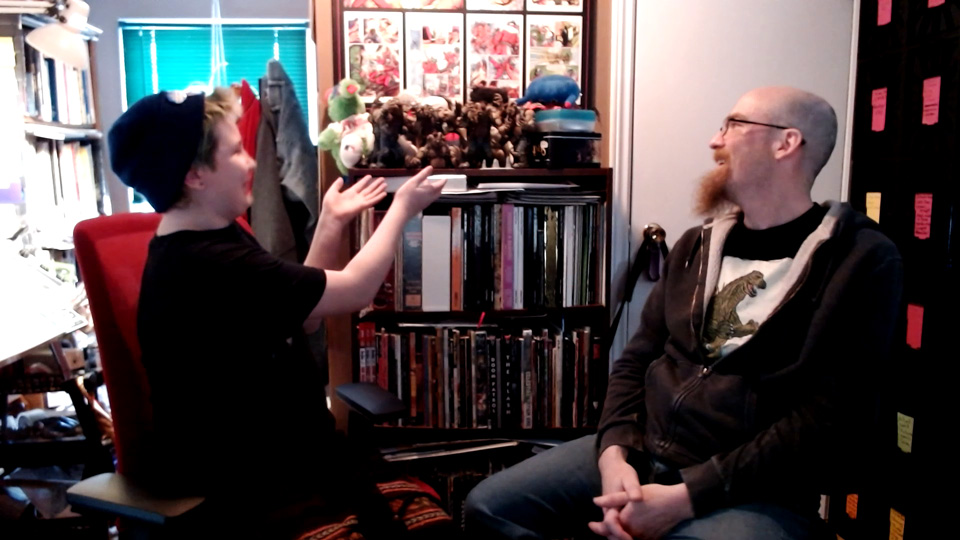
Von Allan: These are my biker trolls! I fell in love with these guys. They were a toy line done years ago. And it was not popular. And I love them. They’re my biker trolls. They were actually for a game. It was a miniature game called SHADOWRUN DUELS. “SHADOWRUN” was actually a role-playing game. And they span out. And they were trying to… A lot of figures for war-gaming and stuff like that are 28mm. They’re very small. And they were...I can’t remember the name of the company doing it. But “SHADOWRUN” anyway, and the gaming company they were working with, were trying to do bigger [figures], sort of merging action figures with 28mm wargaming. With rules and dice and stuff.
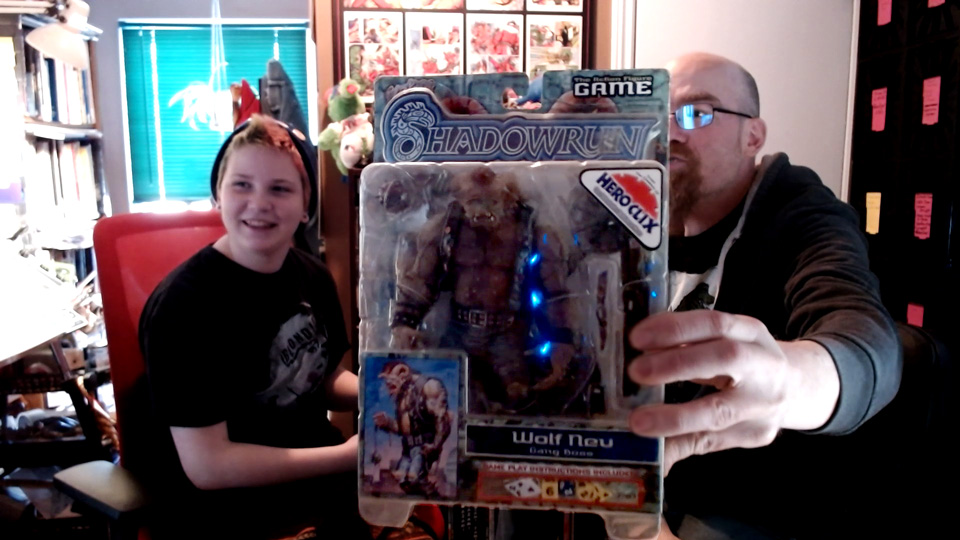
And I love them. I just love them. And I’ve got one unopened one. So there you go. Like he’s a big biker troll. He’s called Wolf Nev. And at some point, when I’m in the mood, I will open it up. But these are not easy to get now. So I was like. ‘I’ll keep one… Open up most of them. And I’ll keep one back.’ Because I love them. So you can see the dice that comes with him. And all the extra stuff. So yeah. Yeah. Anyway. Very good question. Because they are always in my studio. And I look at them and I smile. So there you go.
Cosmo: Thank you. I hope I had interesting questions.
Von Allan: Yeah!


 Posts



